Like many authors writing
historical fiction, I researched my time period extensively. I wanted to
capture day-to-day life, as well as the attitudes and dreams of people living
in past times. In researching the Dust Bowl for COYOTE WINDS, I learned some
surprising facts:
1. The Dust Bowl was a one of the
worst man-made ecological disasters in history.
 Drought, by itself, did not cause
the Dust Bowl. The western Great Plains have always suffered periodic droughts.
But native prairie grasses had deep roots, sometimes five to eight feet deep.
Even when the above-ground shoots dried up, the roots held the soil in place,
and the grasses re-grew quickly when rains returned. During the “Great Plow Up”
of the 1920s, farmers torn out prairie grass in an area as large as Ohio.
They planted wheat, corn and other shallow-rooted crops. They dreamed of a
verdant future because they had been told that “rain follows the plow.” But the rains stopped in 1931, and wind did what it always did—blow. It picked up
dust from Montana to Texas, and the Dust Bowl was spawned. The farmers’ dreams gave
the wind the weapon that then destroyed those dreams.
Drought, by itself, did not cause
the Dust Bowl. The western Great Plains have always suffered periodic droughts.
But native prairie grasses had deep roots, sometimes five to eight feet deep.
Even when the above-ground shoots dried up, the roots held the soil in place,
and the grasses re-grew quickly when rains returned. During the “Great Plow Up”
of the 1920s, farmers torn out prairie grass in an area as large as Ohio.
They planted wheat, corn and other shallow-rooted crops. They dreamed of a
verdant future because they had been told that “rain follows the plow.” But the rains stopped in 1931, and wind did what it always did—blow. It picked up
dust from Montana to Texas, and the Dust Bowl was spawned. The farmers’ dreams gave
the wind the weapon that then destroyed those dreams.
2. Not everyone moved to California.
After John Steinbeck’s novel, The Grapes of Wrath, and the 1940 film, I thought
everyone affected by the Dust Bowl moved west. I was surprised to learn that 75%
of the people in the Dust Bowl area “stuck it out.” More than 2.5 million
people did leave the area, and 300,000 of those went to California. That is a huge migration of economic refugees,
but it was scattered over many states.
3. Grizzly bears, wolves and bald
eagles once were abundant on the Great Plains.
Early settlers saw these predators
as competition for game and a threat to their livestock. So the animals were poisoned,
trapped and hunted relentlessly. And when the buffalo herds were wiped out, the
remaining bear, wolf and eagle populations collapsed. That is one reason why
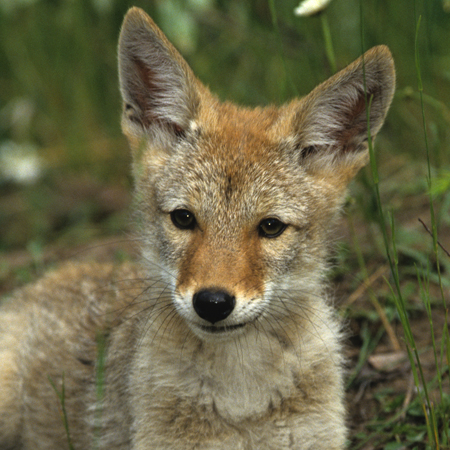
coyotes have thrived so well. Their competition was eliminated, and they filled
the void.
 4. Florence Owens Thompson, the
mother in Dorothea Lang’s famous photo, was only 32 years old.
4. Florence Owens Thompson, the
mother in Dorothea Lang’s famous photo, was only 32 years old.
Hers is a
care-worn face if I have ever seen one.
5. Dust storms cause high static
electricity.
Drivers dragged chains behind their cars to ground them; otherwise
the engine would short out. If you reached out to shake someone’s hand, the
static shock could knock you both off your feet.
6. Dust caused attics to collapse.
People
knew enough to brush the heavy dust from their roofs, but many people did not
realize that dust was seeping into their attics. Many attics collapsed because the
dust was several feet deep.
7. Superstitions were revived.
In
the hope of generating rain, farmers killed snakes and draped their bodies
belly up along fences. So-called experts used balloons to lift dynamite into
the sky. They claimed the explosions “agitated” the atmosphere and caused rain to
fall.
 8. In the 1930s, an estimated half-million teenagers were
riding the rails as “hobos.”
8. In the 1930s, an estimated half-million teenagers were
riding the rails as “hobos.”
We tend to think of hobos as grown men, but
hundreds of thousands of boys, some as young as ten, left home and rode the
rails in search of work and adventure. Some girls joined them. FDR worried that
the country would suffer from this lost generation of hardened, wild children.
9. Tumbleweed—that ubiquitous symbol of the West--came from Russia,
probably mixed in with early sacks of flax seed.
It is a water-hogging,
invasive and hated pest. However cattle will eat the young shoots, so it was
used during the Dust Bowl as cattle feed. Some people tried to eat it as well.
Unsuccessfully.
10. The Dust Bowl has happened again, although on a smaller
scale. Starting in 1952, there was a five-year drought called the “Filthy
Fifties.” Another drought hit in the mid-1970s and again between 1998 and 2002.
Today the area is experiencing another tough drought. Due to better soil
management, dust storms have not been as large and widespread. However if
the Ogallala Aquifer ever runs dry (and some people say it will in about 50
years), we are likely to see more dry, abandoned farmland lose soil to
the coyote winds.
To learn more about the Dust Bowl, watch the Ken Burns special
THE DUST BOWL. The second half will be broadcast on Tuesday April 30, 2013, and
it is available on DVD. http://www.pbs.org/kenburns/dustbowl/
 My novel, COYOTE WINDS, explores the American can-do spirit that
drew people out to the western prairie in the hope of making a new life and
feeding the world. And it shows what happened when that spirit came up against
the Great Depression and the Dust Bowl.
For more information about COYOTE WINDS, visit my website Helen Sedwick Website
My novel, COYOTE WINDS, explores the American can-do spirit that
drew people out to the western prairie in the hope of making a new life and
feeding the world. And it shows what happened when that spirit came up against
the Great Depression and the Dust Bowl.
For more information about COYOTE WINDS, visit my website Helen Sedwick Website